PROOF OF CONCEPT
Q2 2026
SOLUTION HIGHLIGHT
PROBLEM
Routine transactions take 5 to 9 deliberate steps. Friction compounds into lost time, support calls, and abandonment.
5-9
steps to complete a routine transaction
-UXDA Research
68%
users frustrated with digital banking due to navigation complexity
-Harris Poll
Benchmarked against Bank of America Erica's published outcomes and industry averages for chatbot-augmented banking flows.
-65%
reduction in average response time for routine queries
-Industry average
-38%
call centre volume reduction, based on % share of support tickets raised
-American Banker
70%
of users who try the chatbot once return to use it again
-SQ Magazine (2025)
POTENTIAL SOLUTION
Instead of navigating menus, users type what they want. The chatbot interprets intent, performs the pre-authorised action, and confirms in plain language. Support queries are answered inline against the bank's public knowledge base, so users never leave the app.

SOUNDS SIMPLE BUT THERE'S ONE OTHER PROBLEM
Trust is a structural requirement. Once trust is broken, it is very hard to recover. But we can do a few things and design for trust as a foundational requirement.
INTRODUCING STELLA AI - A FINANCIAL CHATBOT YOU CAN TRUST
1
No transaction is executed without a human-readable confirmation screen. The AI interprets and prepares, the user always authorises. This mirrors the mental model of a teller who confirms before acting.

2
Conversations are not stored indefinitely. Users can delete conversation history at any time from settings. 43% of leading banking chatbots now offer this in-app. No conversation data is used for advertising or sold to third parties.

3
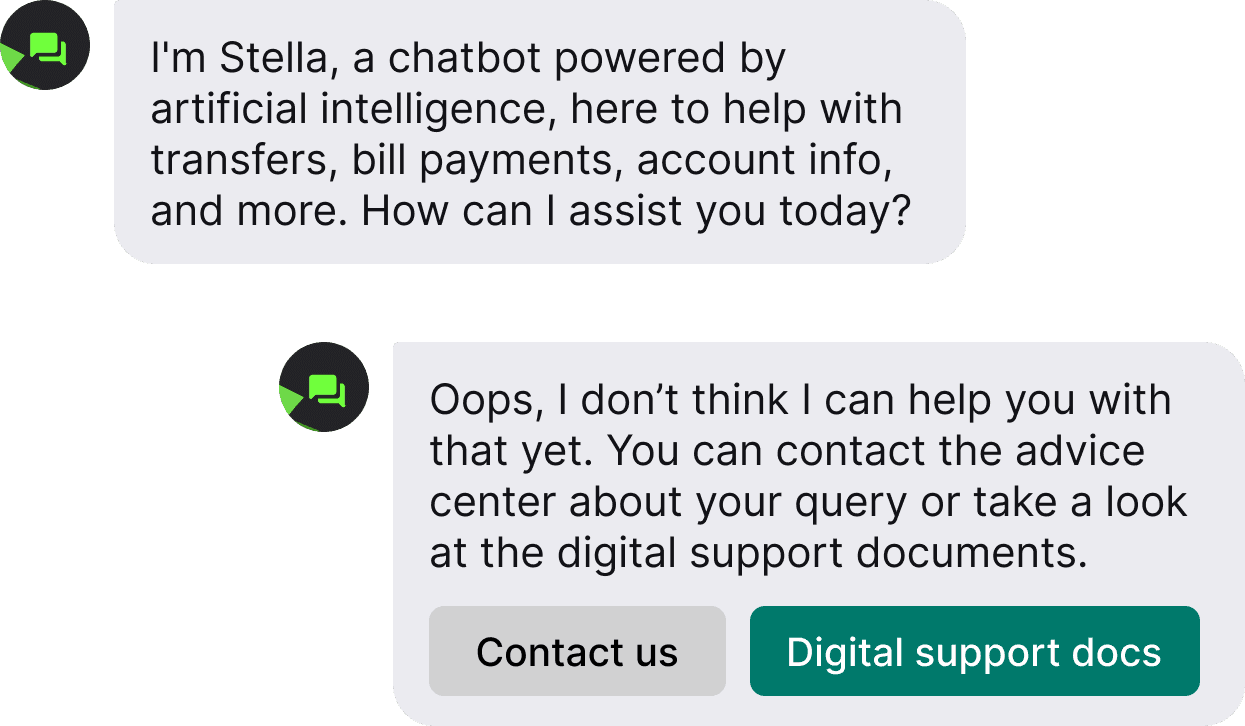
The assistant never pretends to be a human. It identifies itself as an AI at the start of every session and escalates clearly when it cannot help.
4
Transactions above defined thresholds, or new payee additions, require biometric re-authentication (face ID or fingerprint) before execution. By mid-2025, 38% of mobile banking apps implemented AI-powered biometric authentication.

LESSONS
Everyone can work around the technical constraints of implementation but how we govern the AI powered systems is the actual question. Will our users trust this kind of system yet or is it too soon?
Once I designed and prototyped this chatbot, things got real, really fast. This turned out to be a great conversation starter for leaders thinking about implementing some sort of chatbot on our platforms.